
The 39,000-Ton Headache: Breaking Down Malaysia’s Daily Waste Crisis
When you toss something into the bin, it vanishes from your sight—but it doesn’t vanish from the planet.
Right now, Malaysia is facing a quiet but massive environmental challenge. Driven by rapid urbanization and changing consumer habits, our daily trash production has reached staggering new heights.
If you’ve ever wondered exactly how much waste we generate, what’s actually in our bins, and where it all ends up, here is a look at the hard data defining Malaysia’s current waste landscape.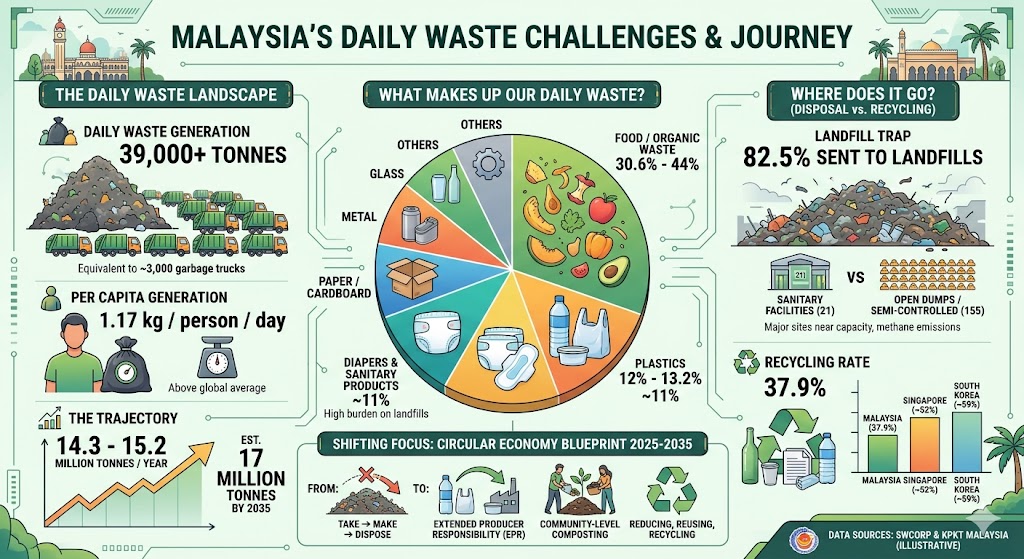
📊 The Daily Waste Landscape by the Numbers
According to official data monitored by Solid Waste and Public Cleansing Management Corporation (SWCorp) and the Ministry of Housing and Local Government (KPKT), the sheer volume of daily waste is growing faster than our infrastructure can keep up:
39,000+ Tonnes Generated Daily: Malaysia produces over 39,000 tonnes of solid municipal waste every single day. To visualize that, it is roughly equivalent to filling 3,000 garbage trucks to the brim, day in and day out.
The Per Capita Burden: The average Malaysian generates about 1.17 kg of waste daily, a figure that sits uncomfortably above global averages for developing nations.
The Upward Trajectory: The nation's total annual waste output hovers between 14.3 and 15.2 million tonnes. If current consumption and disposal habits remain unchanged, experts project this figure will climb to 17 million tonnes by 2035.
🥗 What is Actually in Our Trash?
To solve a problem, you have to understand its composition. Malaysia's daily waste stream is heavily weighed down by organic matter and single-use products:
| Waste Category | Percentage Share | The Core Challenge |
| Food & Organic Waste | 30.6% – 44.0% | The single largest component. When buried in landfills without oxygen, it decomposes to produce highly harmful methane gas. |
| Plastics | 12.0% – 13.2% | Dominated by single-use packaging, bags, and containers that take hundreds of years to degrade. |
| Diapers & Sanitary Products | ~11.0% | A surprisingly massive chunk of the daily waste stream that cannot easily be recycled or composted. |
| Paper, Glass, Metals, & Others | Remaining % | Traditional recyclables that are still frequently mixed into general waste instead of being separated. |
🚚 Where Does It Go? The Landfill Trap vs. Recycling
This is where Malaysia hits its biggest bottleneck. Our current system relies almost entirely on a linear "take, make, dispose" model.
1. Overwhelming Dependence on Landfills
A staggering 82.5% of all daily waste generated in Malaysia is sent directly to landfills.
The crisis worsens when you look at the quality of these sites. Out of the 176 operational landfills across the country, only 21 are engineered sanitary landfills designed to manage hazardous leachate and gases. The remaining 155 are open dumps or semi-controlled sites. Major landfills serving high-density areas in Selangor and Johor are already rapidly approaching maximum capacity.
2. A Climbing (But Lagging) Recycling Rate
On a positive note, Malaysia’s national recycling rate has crept up to 37.9%. While this marks significant progress compared to a decade ago, it still trails behind regional neighbors and global recycling leaders like Singapore (~52%) and South Korea (~59%).
💡 The Way Forward: Shifting to a Circular Economy
We can no longer afford to treat waste as a costly burden; it must be viewed as a resource.
To bridge this gap, the government is leaning heavily into the Circular Economy Blueprint for Solid Waste (2025–2035). The blueprint outlines a crucial framework to reshape how the country handles production and consumption:
Extended Producer Responsibility (EPR): Forcing manufacturers to take accountability for the entire lifecycle of their products, especially packaging.
Community-Level Composting: Targeting the massive 44% food waste problem right at the source before it ever hits a landfill.
Smart Separation & Incentives: Introducing better tracking, ESG data integration, and community incentives to make daily recycling second nature for everyday citizens.
📝 Resource & Data Accreditation
Solid Waste and Public Cleansing Management Corporation (SWCorp Malaysia)
Ministry of Housing and Local Government (KPKT Malaysia)
National Circular Economy Blueprint for Solid Waste Framework